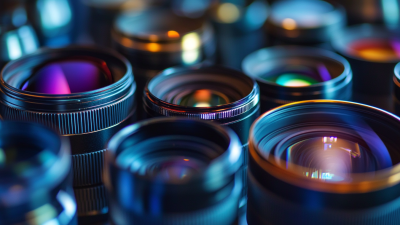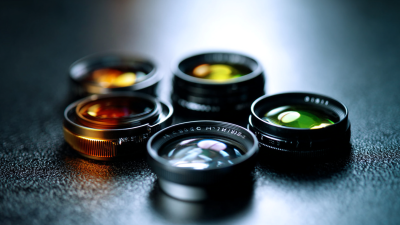

Choosing Tinted Lenses for global markets requires more than selecting an attractive color. Buyers must consider optical performance, comfort, product purpose, and regional customer expectations. A warm brown tint may suit outdoor fashion eyewear, while a soft gray tint can support a more neutral appearance. However, color alone does not prove quality.
Experienced buyers usually review lens materials, tint consistency, surface treatment, and manufacturing controls. Ask suppliers for technical specifications, sample batches, and quality test records. Inspect the lenses under natural daylight and indoor lighting. Uneven shading is easy to miss in photographs. It becomes obvious on a finished frame.
Fit matters too.
Tinted Lenses should provide comfortable vision without distracting color distortion. Buyers should confirm whether the lenses are designed for fashion, daily wear, driving, sports, or strong sunlight. Each use may require different performance expectations. Reliable suppliers can explain light transmission, UV protection claims, coating options, and recommended frame applications clearly.
Global purchasing also requires careful documentation. Product labeling, packaging information, testing methods, and market requirements may differ between regions. Do not assume one certificate satisfies every destination. Independent verification can reduce uncertainty, especially for large orders. Still, even careful checks have limits. A sample may look excellent while later production varies. This is why written specifications, retained samples, and inspection plans are valuable.
The best decision balances appearance, function, consistency, and responsible sourcing. Buyers should compare suppliers carefully, question unclear claims, and test products in realistic conditions. A beautiful tint is useful only when customers can trust its performance.
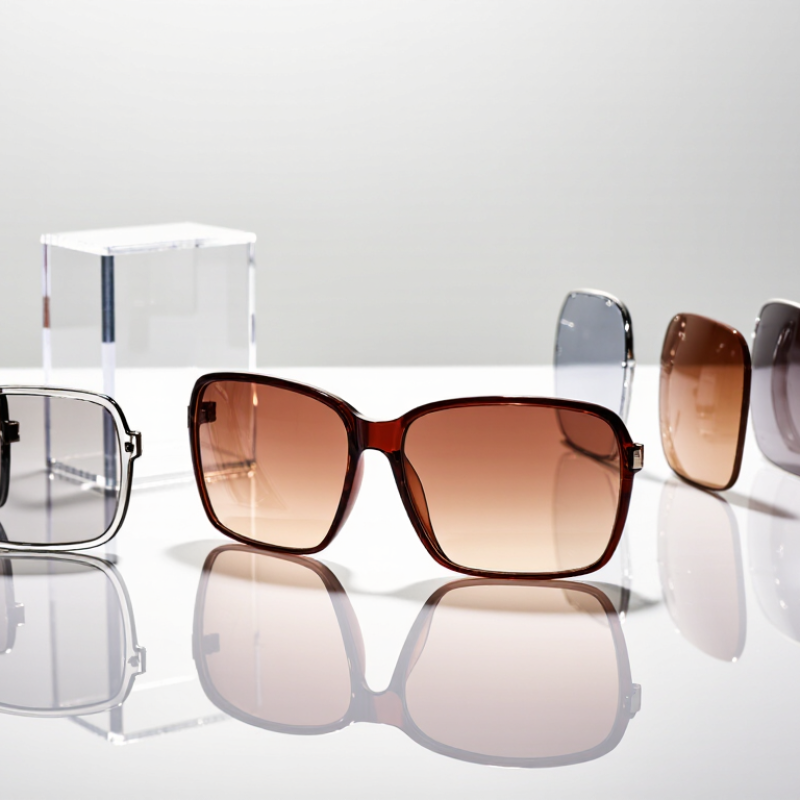
For global buyers, tint should be defined by visible light transmittance (VLT), not by appearance alone. Under EN ISO 12312-1, Category 0 transmits 80–100% of visible light, while Category 1 transmits 43–80%. Category 2 allows 18–43%, and Category 3 allows 8–18%. Category 4 transmits only 3–8% and is not suitable for driving. These ranges help buyers compare samples consistently across markets. However, VLT does not prove ultraviolet protection. Request test results for UV transmittance, optical quality, and lens category.
The World Health Organization’s World Report on Vision estimates that at least 2.2 billion people have a vision impairment, with at least 1 billion cases preventable or still unaddressed. This reinforces the need for clear product information, especially for outdoor workers and older users. In practice, a Category 3 lens may feel comfortable on a bright beach, but it can feel too dark in shaded streets. Product decisions should reflect climate, activity, and likely lighting changes. My own view is that buyers sometimes overvalue a dark tint. That is an easy mistake.
Tips: Ask for the measured VLT, not a color photograph. Check the test date and laboratory scope. Confirm whether the lens marking matches the supplied report. For variable-light use, compare Category 2 and Category 3 samples outdoors before placing a large order.
Tint darkness does not prove ultraviolet protection. A nearly black lens may still transmit harmful UV radiation. The CIE ultraviolet classification places UVB at 280–315 nm and UVA at 315–400 nm. Therefore, buyers should verify coverage across the complete 280–400 nm range, not only one test point.
Ask suppliers for a spectrophotometer report showing wavelength-by-wavelength transmission data. The report should identify the lens sample, testing laboratory, test method, and measurement uncertainty. ISO 12312-1 provides performance requirements for general-use sunglasses, including ultraviolet transmittance. A simple “UV400” label is useful, but it is not enough without supporting results. Look for transmission close to zero throughout the tested range.
The World Health Organization reports that ultraviolet exposure contributes to cataract development, while the International Agency for Research on Cancer classifies solar radiation as carcinogenic to humans. These findings make UV verification a health consideration, not merely a marketing detail.
One practical warning: color can distort judgment. Grey, brown, and green tints may look comfortable, yet their protection levels can differ.
I would also recheck results after coating, edging, and assembly, because the finished lens—not just the raw sheet—reaches the customer. Perfect confidence is difficult without independent testing.
Choosing tinted lenses starts with the visual task, not personal preference. Gray lenses reduce overall brightness while keeping colors relatively natural. They suit driving, beach walks, and bright outdoor work. Brown lenses increase contrast and warmth, helping with trails, changing light, and everyday distance viewing. However, brown may alter color judgment slightly.
Green tints can balance brightness and contrast, making them comfortable for golf, fishing, and long periods outdoors. Yellow lenses brighten low-light scenes and may improve perceived contrast during dawn, dusk, or overcast conditions. They are not ideal for strong sunlight. Tint darkness also matters. A dark lens can feel comfortable but may hide surface details, especially indoors or near stairs. Tint alone does not guarantee UV protection, so check the lens specifications carefully.
Tips: Test the tint in the real setting. View a white page, road markings, and skin tones before choosing. Ask an optician to assess prescription accuracy, fit, and light transmission. I have found that comfort is often more important than a dramatic color effect. Still, personal judgment can be unreliable after a short indoor test. Try the lenses outdoors for several minutes, and reconsider if colors look unnatural, edges appear distorted, or your eyes feel strained.
Match gray, brown, green, and yellow tints to common visual tasks
How to Choose Tinted Lenses for Global Buyers?
Tinted lenses should be assessed as optical products, not only fashion accessories. ISO 8980-1 provides requirements for finished uncut spectacle lenses, including optical power and manufacturing tolerances. Ask for test evidence covering sphere, cylinder, axis, and prism values. A reliable supplier should provide batch identification and laboratory records. Check whether measurements match the ordered prescription across several samples. One lens can pass while a batch still shows variation.
Tips: Request an ISO 8980-1 conformity report. Confirm the test method and equipment used. Review tolerance limits before placing a large order. Inspect lens surfaces under angled light. Tiny waves or scratches may become obvious after edging. Keep retained samples for comparison.
Tint adds another evaluation layer. Examine color uniformity from the center toward the edge. Uneven density can affect appearance and customer confidence. ISO 8980-1 does not replace separate testing for UV transmission, color performance, or coating durability. These properties need clear specifications and suitable test methods. In practice, optical power is easier to verify than visual color consistency. That is a weakness worth admitting. Human color judgment can differ under daylight, showroom lamps, and digital screens. Use controlled lighting and agreed reference samples. Also confirm that tinting does not change measured power beyond the permitted tolerance. Small errors matter.
| Evaluation Dimension | Recommended Check | Reference or Acceptance Point | Illustrative Measurement | Assessment |
|---|---|---|---|---|
| Sphere power | Measure the back vertex power with a calibrated lensmeter at the prescribed reference point. | Compare the absolute deviation with the applicable ISO 8980-1 tolerance for the nominal power range. | Nominal −4.00 D; measured −3.97 D; deviation 0.03 D. | Pass for the stated power band |
| Cylinder power | Measure cylinder magnitude and confirm the cylinder axis at the marked or prescribed reference point. | Use the ISO 8980-1 cylinder-power tolerance applicable to the nominal cylinder range; confirm axis separately. | Nominal −2.00 D at 90°; measured −1.98 D at 89°. | Pass when cylinder and axis limits are met |
| Prismatic power | Check prism amount and base direction using a calibrated instrument and the specified measurement location. | Evaluate against the applicable ISO 8980-1 prism tolerance and the prescription requirement. | Specified 0.50Δ base-in; measured 0.54Δ base-in. | Accept if amount and base are within tolerance |
| Tint uniformity | Measure luminous transmittance at the optical centre and at multiple peripheral points under the same instrument settings. | Set a buyer-defined uniformity limit, such as maximum point-to-point variation of 5 percentage points for a standard cosmetic tint. | Centre 42%; edge readings 40%, 43%, 41%, and 42%; maximum variation 3 percentage points. | Passes the stated internal limit |
| Luminous transmittance | Record visible-light transmittance using a spectrophotometer and report the measurement conditions. | Compare the result with the buyer’s intended use and the applicable national or regional traffic-safety requirements. | Measured luminous transmittance: 42% for a medium cosmetic tint. | Use-dependent; verify local legal limits |
| Ultraviolet transmittance | Measure spectral transmittance across the relevant ultraviolet range rather than estimating UV performance from visible tint density. | Request a documented UV-transmittance result and assess it against the destination market’s applicable requirements. | Reported UVA/UVB transmittance: below the laboratory reporting limit for the tested sample. | Verify test method and report limits |
| Localized optical defects | Inspect the lens under controlled illumination for bubbles, inclusions, scratches, pits, coating defects, and tint spots. | No defect should interfere with vision in the usable optical zone; apply agreed inspection distance and lighting conditions. | No visible bubbles, inclusions, coating voids, or tint spots in the 30 mm inspection zone. | Passes visual inspection |
| Geometric and surface quality | Check diameter, centre thickness, edge thickness, bevel condition, warpage, and surface finish against the purchase specification. | Dimensions must match the approved drawing or order specification; surfaces must be free from processing damage that affects use. | Diameter 70.0 mm specified; measured 70.1 mm. Centre thickness 2.2 mm specified; measured 2.2 mm. | Passes the stated dimensional specification |
| Measurement repeatability | Repeat power and transmittance measurements after instrument verification and record the test environment. | Use a calibrated instrument, controlled reference marks, and a documented repeatability target before approving a batch. | Three sphere readings: −3.97 D, −3.98 D, and −3.97 D; range 0.01 D. | Consistent repeat readings |
Note: ISO 8980-1 applies to uncut finished spectacle lenses and includes requirements for optical properties and tolerances. Exact acceptance limits depend on the lens type, nominal power, measurement point, and edition of the standard. The measurement values above are illustrative quality-control records and are not manufacturer or brand data.
How to Choose Tinted Lenses for Global Buyers?
Confirm Fit, Coatings, Markings, and Regional Import Compliance
Choosing tinted lenses for international markets requires more than selecting a fashionable color. Begin with the actual frame. Check lens width, height, bridge shape, base curve, and pupillary distance. A sample lens should sit evenly inside the frame without pressure points. Wraparound frames need extra care because optical centers can shift. Measure them twice. Small errors can cause discomfort, reflections, or blurred vision.
Coatings also require practical testing. Compare scratch resistance, anti-reflective performance, water behavior, and color consistency under daylight. Confirm that the coating matches the lens material and intended use. Some coatings look clear in a showroom but reveal uneven patches after cleaning. That detail is easy to miss. Ask for technical data, test conditions, and acceptable tolerance ranges rather than relying on general claims.
Markings and import rules vary by destination. Review required information for the lens, package, and shipping documents. This may include material, filter category, light-transmission data, batch identification, warnings, and care instructions. The wording may need to appear in the destination region’s language. Confirm whether tinted lenses are treated as optical products, protective eyewear, or medical devices locally. Customs classification can affect duties and documentation. Ask the importer or local authority to verify the current requirements before production. A familiar label is not always an accepted label. Keep signed specifications, test reports, sample approvals, and supplier declarations in one traceable file.