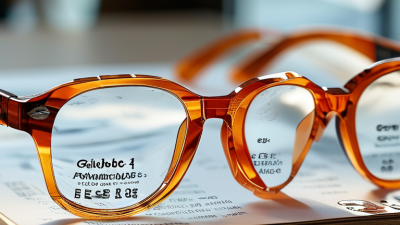
Global buyers are asking a practical question: can a Blue Cut Lens improve daily visual comfort? The demand is understandable. The World Health Organization’s World Report on Vision (2019) identified at least 2.2 billion people with vision impairment worldwide. Meanwhile, Holden and colleagues estimated that nearly half of the global population could be myopic by 2050. Screens are not the only cause, but they have changed how people read, work, and travel.
A Blue Cut Lens filters selected wavelengths from visible blue light. Its performance depends on the coating, substrate, and transmission range. Some lenses appear nearly clear. Others show a slight amber reflection under office lighting. That small detail matters for color-sensitive users, designers, drivers, and photographers. Buyers should request spectral-transmission data, UV protection details, abrasion testing, and compliance with relevant optical standards. Supplier claims need evidence.
The evidence is not perfectly comfortable. A 2023 Cochrane review found that blue-light-filtering lenses may provide little or no short-term benefit for computer-related eye strain. The review also noted limited evidence on sleep and retinal protection. That does not make every Blue Cut Lens useless. It means expectations should remain realistic. Better comfort may come from prescription accuracy, glare control, regular breaks, and improved lighting. The International Commission on Non-Ionizing Radiation Protection has also emphasized that ordinary display exposure should be assessed carefully, not through alarming marketing. A reliable global choice combines transparent testing, professional dispensing, and honest limits. Sometimes, the most trustworthy answer is less dramatic.
Blue light is commonly defined as visible energy between 400 and 500 nanometres. Near 480 nm, melanopsin-sensitive retinal cells respond strongly to light. These cells help regulate alertness and the body’s sleep-wake timing.
Evening exposure may feel different from daytime exposure. The same spectrum does not affect every person equally.
Blue cut lenses filter selected wavelengths rather than removing all blue light. Their actual performance depends on the lens material, coating, and transmission curve.
Global buyers should request independent spectral data, especially around 480 nm. A clear lens may reduce some wavelengths while keeping natural colour perception.
A stronger filter can create a warmer view. That trade-off matters.
The term blue cut sounds more complete than it is. It does not automatically prove better eye protection or prevent digital eye strain.
Evidence remains mixed, and screen brightness, viewing distance, and blinking habits also influence comfort.
In practical testing, I would compare colour accuracy, reflections, and evening use. Fit matters too.
A technically effective lens can still disappoint when its coating scratches easily or its colour feels distracting.
Some claims deserve a second look.
Why Choose Blue Cut Lenses for Global Buyers?
What Research Shows: Digital Eye Strain, Sleep, and Blue-Light Filters
Screens can leave eyes dry, tired, and temporarily blurred. The Vision Council’s 2023 report found that 104 million American adults experienced digital eye strain. However, blue light is only one possible factor. Reduced blinking, glare, poor viewing distance, and long sessions also matter.
Sleep evidence is more specific, but still limited. A 2015 Current Biology study tested 12 adults using light-emitting e-readers for four hours before bedtime. Their melatonin release occurred later, and they felt less alert the next morning. Yet, a 2023 Cochrane Review examined 17 randomized trials involving 619 participants. It found little short-term evidence that blue-light filtering lenses reduce eye strain. Sleep benefits remained uncertain.
The evidence is not tidy. I would not present blue cut lenses as a medical solution. They may feel comfortable in bright offices, especially for people sensitive to glare. Individual experience still matters, but it should not replace clinical advice.
Tips: Keep the screen about an arm’s length away. Follow the 20-20-20 rule: every 20 minutes, look 20 feet away for 20 seconds. Blink deliberately. Reduce evening screen brightness, and stop using strong screens before bed when possible. Choose lenses with tested filter specifications, not vague promises. If pain, persistent blur, or headaches continue, consult an eye-care professional.
For global buyers, blue cut lenses should be judged by measured optical performance, not broad marketing language. Spectral transmission shows how much light passes through each wavelength. A laboratory curve is more useful than a single “blue-blocking” percentage. It should identify the light source, testing interval, and uncertainty.
The cut-off wavelength needs careful definition. Some laboratories report the 50% transmission point, while others describe the first wavelength below a selected transmission level. These values are not interchangeable. The CIE Position Statement on the Blue Light Hazard (2019) places peak hazard weighting near 435–440 nm, but it does not recommend blocking all blue light. The ICNIRP guidelines also assess exposure through weighted radiance, not one isolated wavelength. A lens cutting at 450 nm may reduce selected wavelengths while transmitting much of the visible spectrum. The curve tells the real story.
Color performance matters during daily use. Excessive filtering can create a yellow or gray appearance, especially under cool office lighting. Buyers should request color coordinates, transmittance under standard illuminants, and color difference data such as ΔE00. ISO 8980-3 provides a relevant framework for ophthalmic lens transmittance and optical properties. CIE 015:2018 also supports consistent color measurement practice. I would treat any claim without test conditions cautiously. A clear lens may still alter screen whites slightly. Sometimes, that small shift is noticeable.
Why Choose Blue Cut Lenses for Global Buyers?
Global Compliance: ISO 8980, IEC 62471, and UV400 Testing Requirements
Blue cut lenses need more than a tinted appearance. ISO 8980 testing examines optical performance, including transmittance and lens quality. IEC 62471 evaluates photobiological safety and potential blue-light hazards. UV400 claims should show verified protection against ultraviolet wavelengths below 400 nanometres. Requirements can differ by market, so one certificate rarely proves everything. That detail is easy to miss.
The World Health Organization reports that up to 20% of cataract cases may relate to ultraviolet exposure. Its Global Solar UV Index guidance also confirms that UV exposure can remain significant on bright, reflective days. In practice, buyers should request laboratory reports, test dates, sample identification, and batch traceability. A blue appearance is not proof of compliance. Nor is a marketing statement. Independent testing remains stronger evidence.
Tips: Check ISO 8980 test scope, not only the certificate title. Ask whether IEC 62471 testing covers the finished lens. Confirm UV400 results with wavelength curves. Review documents carefully. Small gaps matter. Some suppliers may provide incomplete files, and buyers should question them before approving production.
Why Choose Blue Cut Lenses for Global Buyers?
Prescription fit should come before blue-light claims. The World Health Organization reports that at least 2.2 billion people have vision impairment worldwide. A small optical error can become uncomfortable during long screen use. Buyers should verify sphere, cylinder, axis, addition, pupillary distance, and fitting height. Confirm whether measurements are monocular or binocular. That detail is often missed.
Coatings need practical evidence. Request abrasion, adhesion, and surface-reflection test results, not only attractive samples. The 2023 Cochrane review examined 17 randomized studies involving 619 participants. It found little evidence that blue-light filtering lenses reduce short-term eye strain. Be careful with promises. A neutral blue-cut design may be more credible than a strongly tinted lens. Ask for spectral-transmission curves and color-shift data. ISO 8980-3 testing can help assess transmittance and optical quality. Color accuracy matters for designers, photographers, drivers, and online shoppers.
Batch consistency requires more than one approved sample. Request inspection records for refractive power, tint density, coating adhesion, and cosmetic defects. ISO 2859-1 sampling methods can support a repeatable acceptance process. Compare results from several production batches. In practice, one batch may look perfect, while the next shows uneven reflections. This is where buyers should remain skeptical. The checklist is useful, but it is not foolproof.
| Evaluation Dimension | Recommended Specification or Data Point | Why It Matters | How Buyers Can Verify It | Suggested Acceptance Checklist |
|---|---|---|---|---|
| Prescription Power | Verify sphere, cylinder, axis, addition, prism, and monocular pupillary distance against the approved order. | Incorrect power or axis can cause blur, discomfort, adaptation problems, and remakes. | Compare the lensmeter or focimeter reading with the signed prescription and order file. | Require a documented tolerance policy based on the applicable spectacle-lens standard and prescription range. |
| Optical Centering | Check monocular PD and fitting height for each eye; do not rely only on total PD. | Accurate centration helps align the optical centers with the wearer’s visual axis and reduces unwanted prismatic effects. | Use a pupilometer, digital centration system, or marked lens verification with the frame and fitting measurements. | Confirm right and left measurements separately, especially for progressive, high-power, and large-size frames. |
| Lens Material | Record refractive index, Abbe value, specific gravity, impact classification, and design type. | Index affects thickness; Abbe value relates to chromatic dispersion; density affects weight. | Request the technical data sheet and match the material code to the production batch. | Use the same material specification throughout a confirmed order unless a change is approved in writing. |
| Blue-Violet Filtering Range | Request the spectral transmittance curve and identify the blocked or reduced range, commonly within approximately 400–455 nm for blue-violet filtering products. | “Blue cut” is not a single universal specification. Different products reduce different portions of the visible spectrum. | Review a spectrophotometer report showing transmittance by wavelength, rather than accepting only a marketing percentage. | Specify the wavelength range, average transmittance, and measurement method in the purchase specification. |
| Visible-Light Transmission | Record photopic transmission, commonly reported as luminous transmittance (Tv). | Excessive reduction of visible light may make lenses appear noticeably tinted and can affect indoor color perception. | Compare the production report with the approved reference sample under the same measurement conditions. | Set an agreed Tv range appropriate to the intended clear, lightly tinted, or tinted lens category. |
| UV Protection | Confirm attenuation of ultraviolet radiation through 400 nm when the product is sold as UV400 or equivalent. | UV protection is a separate performance claim from blue-violet filtering and should not be inferred from lens color. | Request spectral transmission data covering the UV region and check the product marking or test documentation. | Keep UV protection and blue-light filtering as two separate line items in the technical specification. |
| Anti-Reflective Coating | Review residual reflectance, coating color, adhesion, abrasion resistance, and cleaning durability. | Anti-reflective coatings can improve light transmission and reduce visible reflections, while poor adhesion causes peeling or haze. | Inspect under angled light; request coating test results and a written cleaning-care procedure. | Approve a reference sample showing acceptable reflection color, uniformity, and absence of pinholes or coating defects. |
| Hydrophobic and Oleophobic Performance | Check water-shedding and fingerprint-cleaning behavior after the specified durability test. | These top layers improve everyday maintenance but may wear faster with abrasive cleaning or unsuitable chemicals. | Use a documented contact-angle or cleaning-cycle method agreed with the supplier. | Define the minimum test cycles, approved cleaning materials, and inspection criteria before mass production. |
| Color Accuracy | Compare lens appearance and transmission against an approved master sample; use color coordinates or ΔE values where applicable. | Blue-violet filtering may create a warm or yellow appearance, which can affect perceived color neutrality. | Measure samples under a controlled illuminant and viewing condition; visual inspection alone is not sufficient for tight requirements. | Set a buyer-specific tolerance, such as ΔE00 ≤ 2 for close matching or a wider tolerance for lightly tinted products. |
| Lens Surface Quality | Inspect for scratches, pits, bubbles, inclusions, waves, coating spots, edge chips, and polishing marks. | Surface defects can reduce optical quality, appearance, and coating life. | Inspect clean lenses under controlled illumination and at a defined viewing distance and angle. | Use an agreed defect classification with clear limits for cosmetic and functional defects. |
| Geometric Accuracy | Check diameter, center thickness, edge thickness, base curve, bevel, shape, and mounting dimensions. | Dimensional variation can cause fitting problems, frame stress, decentration, or inconsistent finished appearance. | Measure with calibrated thickness gauges, optical instruments, templates, or digital inspection equipment. | Approve dimensional tolerances for each lens design and identify critical-to-function measurements. |
| Batch-to-Batch Consistency | Track prescription power, Tv, spectral transmittance, color appearance, coating reflectance, and dimensions by lot. | Consistent batches reduce customer complaints, replacement costs, and unexpected appearance differences. | Request a batch inspection report containing sample size, test method, measured results, and lot identification. | Retain an approved golden sample and compare every production lot against the same specification. |
| Sampling and Inspection | Use a written sampling plan with defined critical, major, and minor defect limits. | A repeatable plan makes acceptance decisions more objective than visual spot checks. | Record lot size, sample quantity, nonconformities, reinspection rules, and final disposition. | Apply the same inspection procedure to incoming goods, pre-shipment checks, and complaint investigations. |
| Traceability | Maintain order number, prescription file, lens design, material, coating stack, production date, and batch code. | Traceability makes it possible to isolate defects and verify whether replacement lenses match the original specification. | Check that packaging, labels, inspection reports, and production records use consistent identifiers. | Require traceability records to remain available for the agreed retention period. |
| Packaging and Transport | Use protective sleeves, separation between lenses, moisture control where needed, and impact-resistant outer cartons. | Correctly manufactured lenses can still arrive scratched, warped, or mixed if packaging is inadequate. | Perform carton inspection, random package opening, and photo documentation before shipment acceptance. | Define acceptable packaging damage, labeling requirements, and responsibility for transit-related claims. |
| Claims and Health Communication | Separate measurable optical claims from medical or wellness claims; provide only substantiated performance information. | Blue-light filtering does not automatically prove prevention of eye disease, and product claims vary by market and evidence level. | Review test reports, product labeling, and destination-market regulatory requirements before publication or sale. | Use factual wording such as “reduces selected wavelengths” unless a broader claim is supported by appropriate evidence. |